
Explore Rhea#
Exploring Rhea from a network perspective
Loading the node and edge info#
from lipinet.parse_rhea import parse_rhea_data

rhea_results = parse_rhea_data(verbose=False)
df_rhea_nodes = rhea_results['df_nodes']
df_rhea_edges = rhea_results['df_edges']
df_rhea_nodes
| node_id | Equation | ChEBI identifier | chebi_name | EC number | Enzymes | Gene Ontology | Cross-reference (Reactome) | layer | ec_level | |
|---|---|---|---|---|---|---|---|---|---|---|
| 0 | RHEA:21252 | (S)-2-hydroxyglutarate + A = 2-oxoglutarate + AH2 | CHEBI:16782;CHEBI:13193;CHEBI:16810;CHEBI:17499 | (S)-2-hydroxyglutarate;A;2-oxoglutarate;AH2 | EC:1.1.99.2 | 4258.0 | GO:0047545 2-hydroxyglutarate dehydrogenase ac... | NaN | rhea_reactionid | NaN |
| 1 | RHEA:21256 | 3-phosphoshikimate + phosphoenolpyruvate = 5-O... | CHEBI:145989;CHEBI:58702;CHEBI:57701;CHEBI:43474 | 3-phosphoshikimate;phosphoenolpyruvate;5-O-(1-... | EC:2.5.1.19 | 44340.0 | GO:0003866 3-phosphoshikimate 1-carboxyvinyltr... | NaN | rhea_reactionid | NaN |
| 2 | RHEA:21260 | [thioredoxin]-disulfide + L-methionine + H2O =... | CHEBI:50058;CHEBI:57844;CHEBI:15377;CHEBI:5877... | L-cystine residue;L-methionine;H2O;L-methionin... | EC:1.8.4.14 | 3112.0 | GO:0033745 L-methionine-(R)-S-oxide reductase ... | NaN | rhea_reactionid | NaN |
| 3 | RHEA:21264 | glycolate + A = glyoxylate + AH2 | CHEBI:29805;CHEBI:13193;CHEBI:36655;CHEBI:17499 | glycolate;A;glyoxylate;AH2 | EC:1.1.99.14 | 14321.0 | GO:0019154 glycolate dehydrogenase activity | NaN | rhea_reactionid | NaN |
| 4 | RHEA:21268 | (R)-canadine + 2 NADP(+) = berberine + 2 NADPH... | CHEBI:18146;CHEBI:58349;CHEBI:16118;CHEBI:5778... | (R)-canadine;NADP(+);berberine;NADPH;H(+) | EC:1.5.1.31 | 0.0 | GO:0050623 berberine reductase activity | NaN | rhea_reactionid | NaN |
| ... | ... | ... | ... | ... | ... | ... | ... | ... | ... | ... |
| 37990 | EC:1.14.13.35 | NaN | NaN | NaN | NaN | NaN | NaN | NaN | rhea_ec | full_ec |
| 37991 | EC:2.5.1.59 | NaN | NaN | NaN | NaN | NaN | NaN | NaN | rhea_ec | full_ec |
| 37992 | EC:2.5.1.60 | NaN | NaN | NaN | NaN | NaN | NaN | NaN | rhea_ec | full_ec |
| 37993 | EC:2.7.7.6 | NaN | NaN | NaN | NaN | NaN | NaN | NaN | rhea_ec | full_ec |
| 37994 | EC:2.7.7.48 | NaN | NaN | NaN | NaN | NaN | NaN | NaN | rhea_ec | full_ec |
37995 rows × 10 columns
df_rhea_edges
| source_id | target_id | ec_level | source_layer | target_layer | interlayer | edge_type | |
|---|---|---|---|---|---|---|---|
| 0 | EC:1 | EC:1.1 | main_class->subclass | rhea_ec | rhea_ec | False | ec_hierarchy |
| 1 | EC:2 | EC:2.5 | main_class->subclass | rhea_ec | rhea_ec | False | ec_hierarchy |
| 2 | EC:1 | EC:1.8 | main_class->subclass | rhea_ec | rhea_ec | False | ec_hierarchy |
| 3 | EC:1 | EC:1.5 | main_class->subclass | rhea_ec | rhea_ec | False | ec_hierarchy |
| 4 | EC:6 | EC:6.3 | main_class->subclass | rhea_ec | rhea_ec | False | ec_hierarchy |
| ... | ... | ... | ... | ... | ... | ... | ... |
| 108434 | RHEA:21240 | EC:2.5.1.59 | NaN | rhea_reactionid | rhea_ec | False | reaction_ec |
| 108435 | RHEA:21240 | EC:2.5.1.60 | NaN | rhea_reactionid | rhea_ec | False | reaction_ec |
| 108436 | RHEA:21244 | EC:2.1.1.70 | NaN | rhea_reactionid | rhea_ec | False | reaction_ec |
| 108437 | RHEA:21248 | EC:2.7.7.6 | NaN | rhea_reactionid | rhea_ec | False | reaction_ec |
| 108438 | RHEA:21248 | EC:2.7.7.48 | NaN | rhea_reactionid | rhea_ec | False | reaction_ec |
108439 rows × 7 columns
from graph_tool.all import Graph, GraphView, graph_draw
import graph_tool as gt

from onionnet import OnionNet
import onionnet.visualisation

import pandas as pd

import onionnet.exporter
Building the network with OnionNet#
onion = OnionNet()

onion.grow_onion(df_nodes=df_rhea_nodes,
           df_edges=df_rhea_edges,
           node_prop_cols=df_rhea_nodes.columns.to_list(),
           edge_prop_cols=df_rhea_edges.columns.to_list(),
           drop_na=True,
           drop_duplicates=True)
onion.core.graph
<Graph object, directed, with 37995 vertices and 98225 edges, 12 internal vertex properties, 7 internal edge properties, at 0x307136870>
list(onion.core.graph.vp)
['layer_hash',
 'node_id_hash',
 'node_id',
 'Equation',
 'ChEBI identifier',
 'chebi_name',
 'EC number',
 'Enzymes',
 'Gene Ontology',
 'Cross-reference (Reactome)',
 'layer',
 'ec_level']
df_rhea_nodes.info()
<class 'pandas.core.frame.DataFrame'>
RangeIndex: 37995 entries, 0 to 37994
Data columns (total 10 columns):
 #   Column                      Non-Null Count  Dtype
---  ------                      --------------  -----
 0   node_id                     37995 non-null  object
 1   Equation                    17783 non-null  object
 2   ChEBI identifier            17783 non-null  object
 3   chebi_name                  31506 non-null  object
 4   EC number                   7569 non-null   object
 5   Enzymes                     17783 non-null  float64
 6   Gene Ontology               4385 non-null   object
 7   Cross-reference (Reactome)  913 non-null    object
 8   layer                       37995 non-null  object
 9   ec_level                    6489 non-null   object
dtypes: float64(1), object(9)
memory usage: 2.9+ MB
Decode property labels that were encoded
onion.decode_property_labels_bulk(df=df_rhea_nodes, encoded_prop_type='v')
V property 'node_id_decoded' created successfully.
V property 'equation_decoded' created successfully.
V property 'chebi_identifier_decoded' created successfully.
V property 'chebi_name_decoded' created successfully.
V property 'ec_number_decoded' created successfully.
Enzymes prop left as is, no decoding needed (not an object type)
V property 'gene_ontology_decoded' created successfully.
V property 'cross_reference_reactome_decoded' created successfully.
V property 'layer_decoded' created successfully.
V property 'ec_level_decoded' created successfully.
onion.decode_property_labels_bulk(df=df_rhea_edges, encoded_prop_type='e')
E property 'source_id_decoded' created successfully.
E property 'target_id_decoded' created successfully.
E property 'ec_level_decoded' created successfully.
E property 'source_layer_decoded' created successfully.
E property 'target_layer_decoded' created successfully.
interlayer prop left as is, no decoding needed (not an object type)
E property 'edge_type_decoded' created successfully.
df_rhea_edges.info()
<class 'pandas.core.frame.DataFrame'>
RangeIndex: 108439 entries, 0 to 108438
Data columns (total 7 columns):
 #   Column        Non-Null Count   Dtype
---  ------        --------------   -----
 0   source_id     108439 non-null  object
 1   target_id     98225 non-null   object
 2   ec_level      6482 non-null    object
 3   source_layer  108439 non-null  object
 4   target_layer  108439 non-null  object
 5   interlayer    108439 non-null  bool
 6   edge_type     108439 non-null  object
dtypes: bool(1), object(6)
memory usage: 5.1+ MB
onion.core.layer_code_to_name
{0: 'rhea_reactionid', 1: 'rhea_chebiid', 2: 'rhea_ec'}
Filtering the network#
Getting all the EC nodes and visualising#
filter1 = lambda v: onion.core.graph.vp['layer_decoded'][v] == 'rhea_ec'
filtered_view = onion.searcher.compose_filters(filter_funcs=[filter1], mode="or")
filtered_view
<GraphView object, directed, with 6489 vertices and 6482 edges, 21 internal vertex properties, 13 internal edge properties, edges filtered by (<EdgePropertyMap object with value type 'bool', for Graph 0x30667fe00, at 0x30c3f5250>, False), vertices filtered by (<VertexPropertyMap object with value type 'bool', for Graph 0x30667fe00, at 0x16dee7980>, False), at 0x30667fe00>
onionnet.exporter.export_info(filtered_view, mode='v')
| v_int | layer_hash | node_id_hash | node_id | Equation | ChEBI identifier | chebi_name | EC number | Enzymes | Gene Ontology | ... | ec_level | node_id_decoded | equation_decoded | chebi_identifier_decoded | chebi_name_decoded | ec_number_decoded | gene_ontology_decoded | cross_reference_reactome_decoded | layer_decoded | ec_level_decoded | |
|---|---|---|---|---|---|---|---|---|---|---|---|---|---|---|---|---|---|---|---|---|---|
| 0 | 31506 | 2 | 31506 | 31506 | 17783 | 17258 | 30647 | 13 | NaN | 6 | ... | 1 | EC:1 | nan | nan | nan | nan | nan | nan | rhea_ec | main_class |
| 1 | 31507 | 2 | 31507 | 31507 | 17783 | 17258 | 30647 | 13 | NaN | 6 | ... | 1 | EC:2 | nan | nan | nan | nan | nan | nan | rhea_ec | main_class |
| 2 | 31508 | 2 | 31508 | 31508 | 17783 | 17258 | 30647 | 13 | NaN | 6 | ... | 1 | EC:6 | nan | nan | nan | nan | nan | nan | rhea_ec | main_class |
| 3 | 31509 | 2 | 31509 | 31509 | 17783 | 17258 | 30647 | 13 | NaN | 6 | ... | 1 | EC:3 | nan | nan | nan | nan | nan | nan | rhea_ec | main_class |
| 4 | 31510 | 2 | 31510 | 31510 | 17783 | 17258 | 30647 | 13 | NaN | 6 | ... | 1 | EC:5 | nan | nan | nan | nan | nan | nan | rhea_ec | main_class |
| ... | ... | ... | ... | ... | ... | ... | ... | ... | ... | ... | ... | ... | ... | ... | ... | ... | ... | ... | ... | ... | ... |
| 6484 | 37990 | 2 | 37990 | 37990 | 17783 | 17258 | 30647 | 13 | NaN | 6 | ... | 4 | EC:1.14.13.35 | nan | nan | nan | nan | nan | nan | rhea_ec | full_ec |
| 6485 | 37991 | 2 | 37991 | 37991 | 17783 | 17258 | 30647 | 13 | NaN | 6 | ... | 4 | EC:2.5.1.59 | nan | nan | nan | nan | nan | nan | rhea_ec | full_ec |
| 6486 | 37992 | 2 | 37992 | 37992 | 17783 | 17258 | 30647 | 13 | NaN | 6 | ... | 4 | EC:2.5.1.60 | nan | nan | nan | nan | nan | nan | rhea_ec | full_ec |
| 6487 | 37993 | 2 | 37993 | 37993 | 17783 | 17258 | 30647 | 13 | NaN | 6 | ... | 4 | EC:2.7.7.6 | nan | nan | nan | nan | nan | nan | rhea_ec | full_ec |
| 6488 | 37994 | 2 | 37994 | 37994 | 17783 | 17258 | 30647 | 13 | NaN | 6 | ... | 4 | EC:2.7.7.48 | nan | nan | nan | nan | nan | nan | rhea_ec | full_ec |
6489 rows × 22 columns
At first it might look like we have an error here with the Equation, ChEBI identifier, chebi_name and EC number values, afterall why would the ChEBI Identifier values for all EC cells be 17093?
But remember that these are the column values as encoded values; we are more interested instead in their values after decoding (e.g. chebi_identifier_decoded). In which case they are all nan, as we would expect since these EC numbers don’t have ChEBI values etc.
onionnet.exporter.export_info(filtered_view, mode='v')[['layer_decoded','ec_level_decoded']].value_counts()
layer_decoded  ec_level_decoded
rhea_ec        full_ec             6153
               subsubclass          253
               subclass              76
               main_class             7
Name: count, dtype: int64
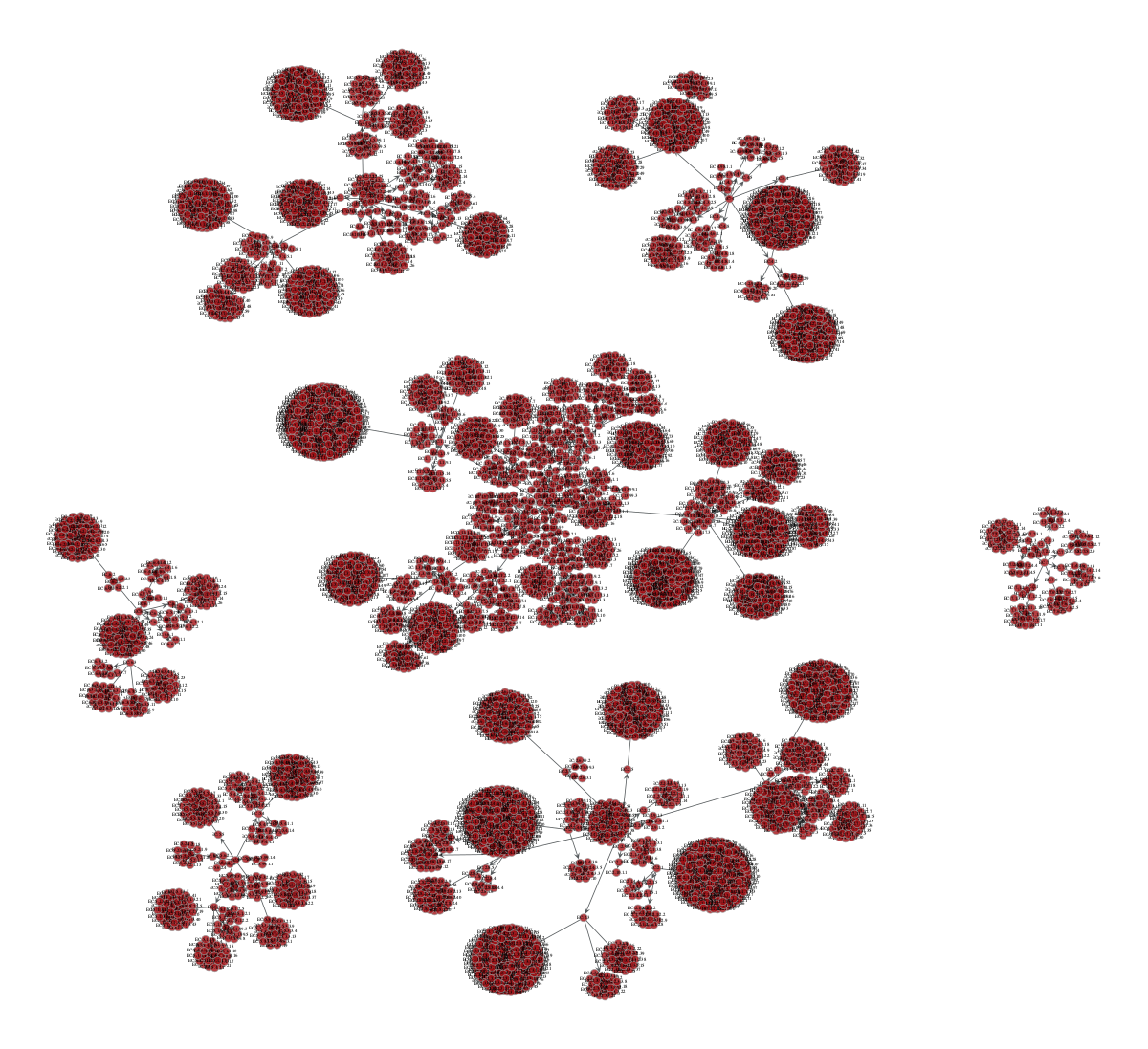
Now we can view the 7 ‘families’ of Enzyme Classifications
graph_draw(
    filtered_view,
    vertex_text=filtered_view.vp['node_id_decoded'],
    vertex_text_position=-2,
    vertex_size=4,
    vertex_text_color='black'
    )
<VertexPropertyMap object with value type 'vector<double>', for Graph 0x30667fe00, at 0x306ef8380>
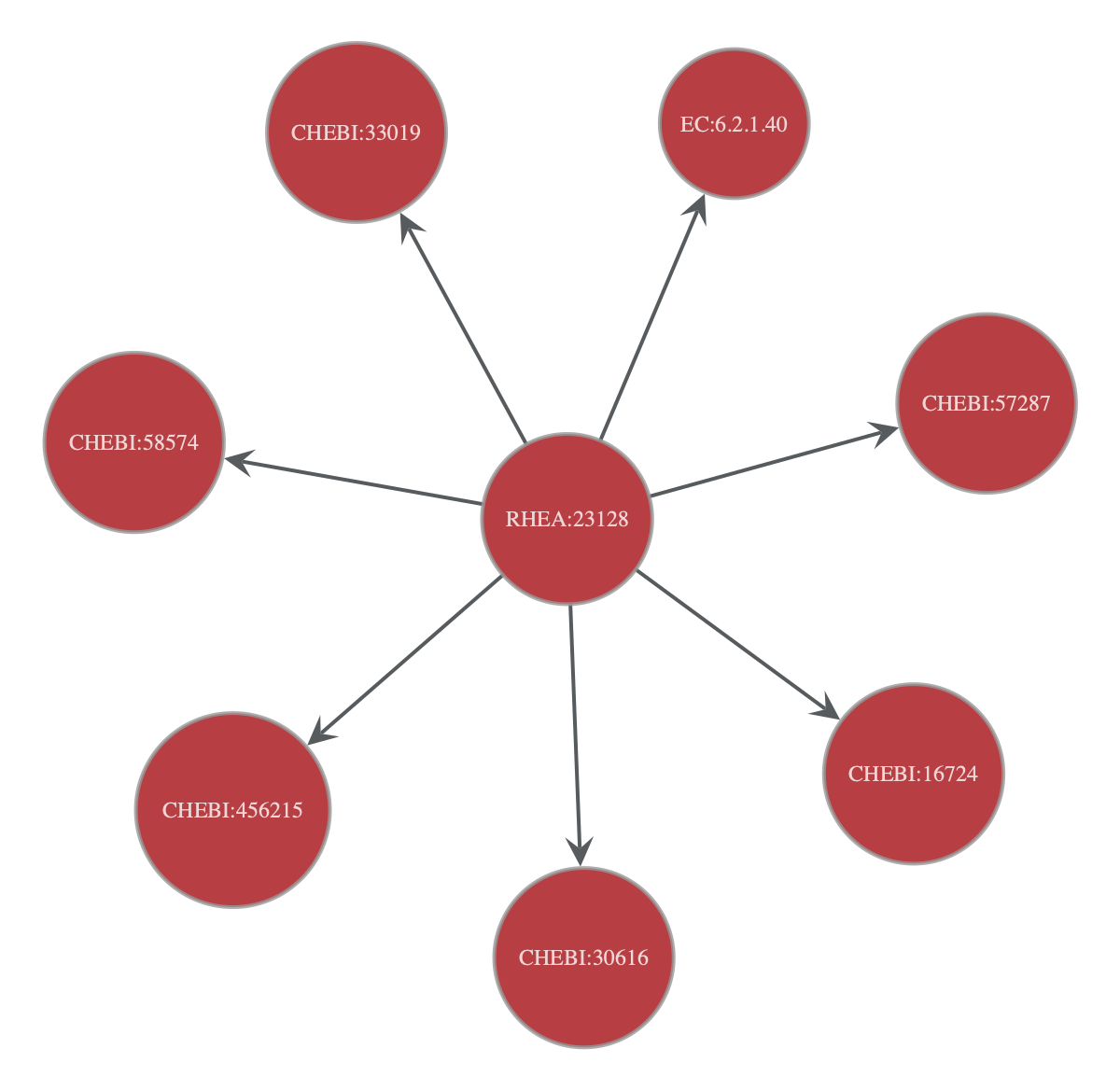
Getting specific nodes based on the reaction IDs (e.g. RHEA:23128)#
# search for a specific node (noi = node of interest)
noi = onion.get_vertex_by_name_tuple(layer_name='rhea_reactionid', node_id_str='RHEA:23128')

onion.searcher.search(start_node_idx=noi,
                      max_dist=2,
                      node_text_prop='node_id_decoded',
                      vertex_text_position=-1,
                      vertex_size=20)
Filtered graph contains 8 vertices and 7 edges.
<GraphView object, directed, with 8 vertices and 7 edges, 21 internal vertex properties, 13 internal edge properties, edges filtered by (<EdgePropertyMap object with value type 'bool', for Graph 0x1049288c0, at 0x16dee7200>, False), vertices filtered by (<VertexPropertyMap object with value type 'bool', for Graph 0x1049288c0, at 0x31518e5d0>, False), at 0x1049288c0>
df_rhea_edges[df_rhea_edges['target_layer']=='rhea_chebiid']['target_id'].value_counts()[:30]
target_id
CHEBI:15378     9932
CHEBI:15377     6485
CHEBI:15379     2851
CHEBI:57287     1567
CHEBI:58349     1335
CHEBI:57783     1329
CHEBI:30616     1328
CHEBI:57540     1207
CHEBI:33019     1188
CHEBI:57945     1136
CHEBI:16526     1058
CHEBI:43474     1029
CHEBI:59789      935
CHEBI:456216     865
CHEBI:58210      861
CHEBI:57856      854
CHEBI:57618      852
CHEBI:58223      637
CHEBI:28938      543
CHEBI:456215     529
CHEBI:13193      475
CHEBI:17499      475
CHEBI:16240      461
CHEBI:16810      449
CHEBI:57288      381
CHEBI:30031      349
CHEBI:29033      266
CHEBI:33738      263
CHEBI:33737      263
CHEBI:29101      259
Name: count, dtype: int64
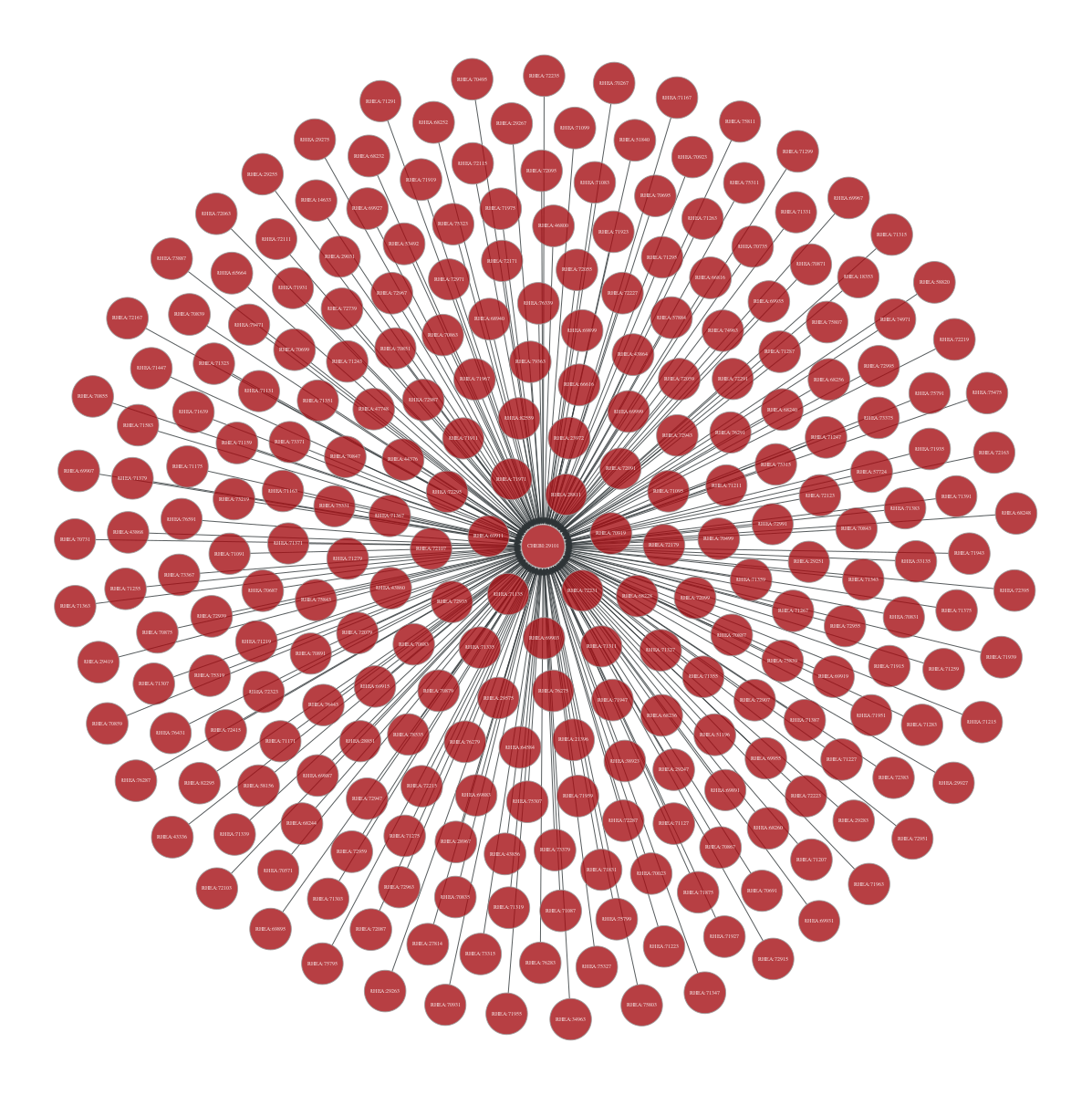
Getting specific nodes based on the chebi IDs (e.g. CHEBI:29101)#
# search for a specific node (noi = node of interest)
noi = onion.get_vertex_by_name_tuple(layer_name='rhea_chebiid', node_id_str='CHEBI:29101')

onion.searcher.search(start_node_idx=noi,
                      max_dist=4,
                      node_text_prop='node_id_decoded',
                      vertex_text_position=-1,
                      vertex_size=5,
                      direction='bi')
Filtered graph contains 260 vertices and 259 edges.
<GraphView object, directed, with 260 vertices and 259 edges, 21 internal vertex properties, 13 internal edge properties, edges filtered by (<EdgePropertyMap object with value type 'bool', for Graph 0x31518fb00, at 0x16e0ef2c0>, False), vertices filtered by (<VertexPropertyMap object with value type 'bool', for Graph 0x31518fb00, at 0x3161665d0>, False), at 0x31518fb00>
Getting all nodes up and/or downstream of a particular EC number (e.g. EC:6.2.1.40)#
We can begin with a bidirectional search of a certain EC number (note this was in the visualisation filter we did earlier)
# search for a specific node (noi = node of interest)
noi = onion.get_vertex_by_name_tuple(layer_name='rhea_ec', node_id_str='EC:6.2.1.40')

onion.searcher.search(start_node_idx=noi,
                      max_dist=4,
                      node_text_prop='node_id_decoded',
                      vertex_text_position=-1,
                      vertex_size=15,
                      direction='bi')
Filtered graph contains 5 vertices and 4 edges.
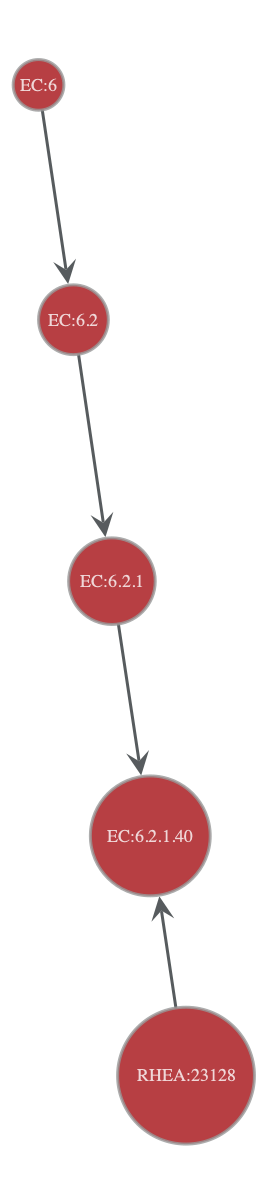
<GraphView object, directed, with 5 vertices and 4 edges, 21 internal vertex properties, 13 internal edge properties, edges filtered by (<EdgePropertyMap object with value type 'bool', for Graph 0x31518ce00, at 0x316164f20>, False), vertices filtered by (<VertexPropertyMap object with value type 'bool', for Graph 0x31518ce00, at 0x316165460>, False), at 0x31518ce00>
Or we could also pick a higher level of EC and then get all the children of that node
# search for a specific node (noi = node of interest)
noi = onion.get_vertex_by_name_tuple(layer_name='rhea_ec', node_id_str='EC:6.2.1')

onion.searcher.search(start_node_idx=noi,
                      max_dist=4,
                      node_text_prop='node_id_decoded',
                      vertex_text_position=-1,
                      vertex_size=13,
                      direction='bi')
Filtered graph contains 75 vertices and 74 edges.
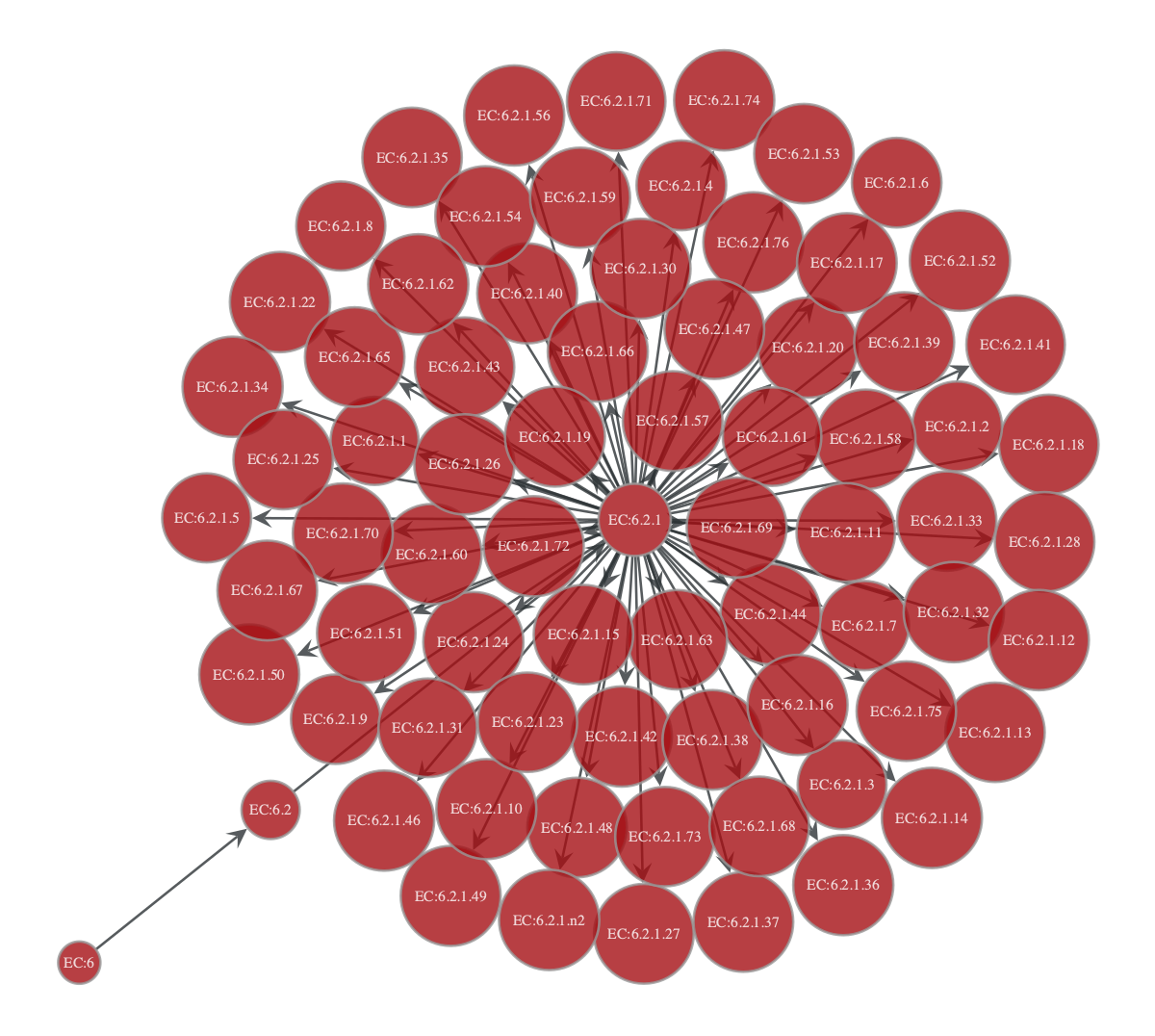
<GraphView object, directed, with 75 vertices and 74 edges, 21 internal vertex properties, 13 internal edge properties, edges filtered by (<EdgePropertyMap object with value type 'bool', for Graph 0x307136750, at 0x316165700>, False), vertices filtered by (<VertexPropertyMap object with value type 'bool', for Graph 0x307136750, at 0x316165190>, False), at 0x307136750>
Combining multiple conditional filters using lambda and onion.compose_filters()#
We can combine filters using lambda and onion.compose_filters(). We can use either and or or modes.
For example we might want to filter those nodes where the ec_level_decoded is either main class or subclass.
filter1 = lambda v: onion.core.graph.vp['ec_level_decoded'][v] == 'main_class'
filter2 = lambda v: onion.core.graph.vp['ec_level_decoded'][v] == 'subclass'
filtered_view = onion.compose_filters([filter1, filter2], mode="or")
filtered_view
<GraphView object, directed, with 83 vertices and 76 edges, 21 internal vertex properties, 13 internal edge properties, edges filtered by (<EdgePropertyMap object with value type 'bool', for Graph 0x30c3f6de0, at 0x31518e0f0>, False), vertices filtered by (<VertexPropertyMap object with value type 'bool', for Graph 0x30c3f6de0, at 0x30c3f6960>, False), at 0x30c3f6de0>
graph_draw(
    filtered_view,
    vertex_size=12,
    vertex_text_color='black',
    vertex_text=filtered_view.vp['node_id_decoded'],
    )
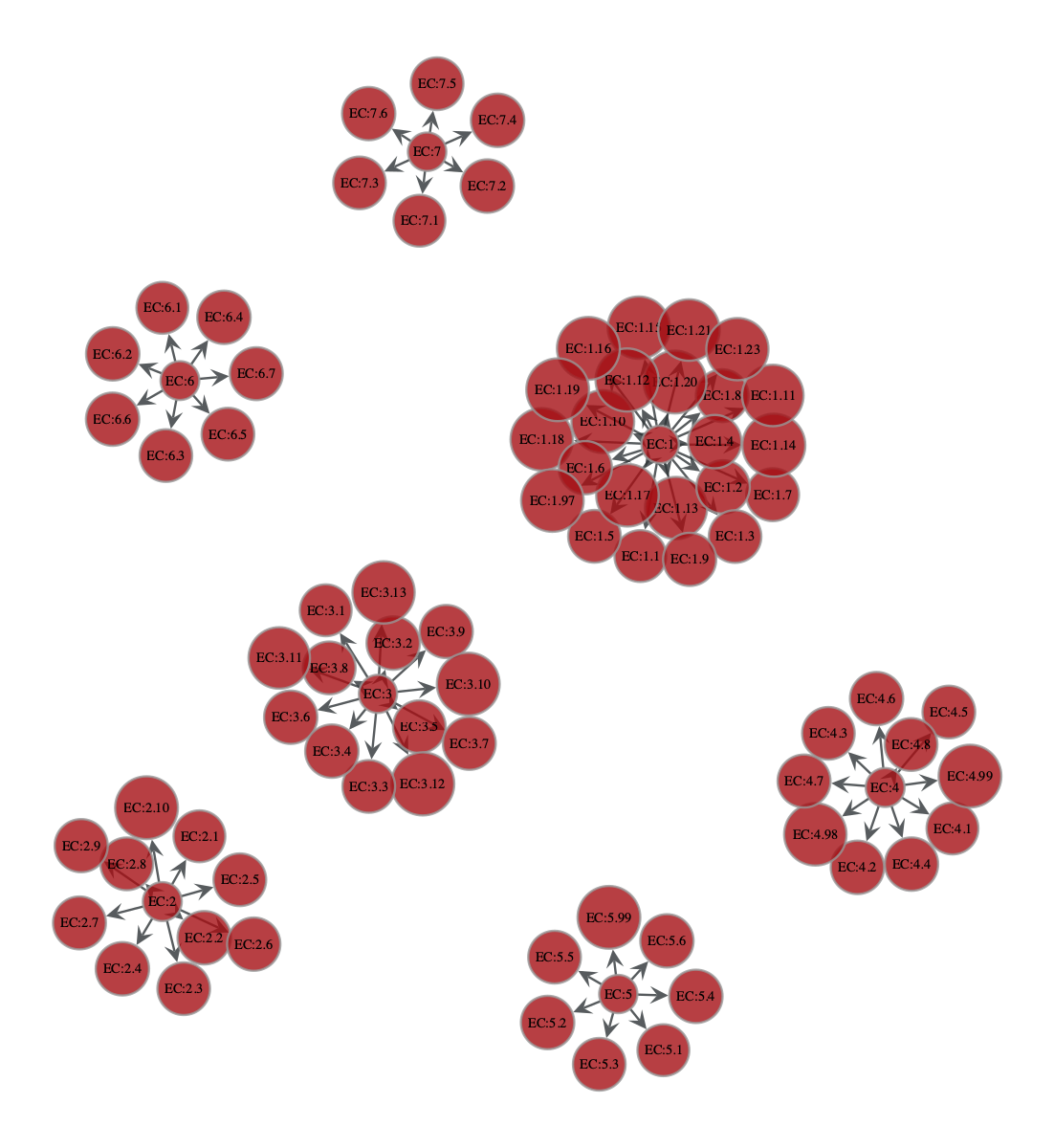
<VertexPropertyMap object with value type 'vector<double>', for Graph 0x30c3f6de0, at 0x315dbf410>
Analyse the Rhea network#
Now that we’ve shown how to build and filter the Rhea network, what can we actually do with it to start generating interesting insights?
We could start by answering the following basic questions:
Which ChEBI compounds are mostly commonly involved in Rhea reactions?
Which reactions have the largest number of compounds involved?
What are the ‘bottleneck’ reactions? (i.e. betweenness on reactions that share a compound)
Identify the top metabolic ‘hub’ compounds#
filter1 = lambda v: onion.core.graph.vp['layer_decoded'][v] != 'rhea_ec'
filtered_view = onion.searcher.compose_filters(filter_funcs=[filter1], mode="or")
filtered_view
<GraphView object, directed, with 31506 vertices and 83885 edges, 21 internal vertex properties, 13 internal edge properties, edges filtered by (<EdgePropertyMap object with value type 'bool', for Graph 0x316165fd0, at 0x30c3f6f60>, False), vertices filtered by (<VertexPropertyMap object with value type 'bool', for Graph 0x316165fd0, at 0x316166f00>, False), at 0x316165fd0>
onionnet.exporter.export_info(filtered_view, mode='v')
| v_int | layer_hash | node_id_hash | node_id | Equation | ChEBI identifier | chebi_name | EC number | Enzymes | Gene Ontology | ... | ec_level | node_id_decoded | equation_decoded | chebi_identifier_decoded | chebi_name_decoded | ec_number_decoded | gene_ontology_decoded | cross_reference_reactome_decoded | layer_decoded | ec_level_decoded | |
|---|---|---|---|---|---|---|---|---|---|---|---|---|---|---|---|---|---|---|---|---|---|
| 0 | 0 | 0 | 0 | 0 | 0 | 0 | 0 | 0 | 4258.0 | 0 | ... | 0 | RHEA:21252 | (S)-2-hydroxyglutarate + A = 2-oxoglutarate + AH2 | CHEBI:16782;CHEBI:13193;CHEBI:16810;CHEBI:17499 | (S)-2-hydroxyglutarate;A;2-oxoglutarate;AH2 | EC:1.1.99.2 | GO:0047545 2-hydroxyglutarate dehydrogenase ac... | nan | rhea_reactionid | nan |
| 1 | 1 | 0 | 1 | 1 | 1 | 1 | 1 | 1 | 44340.0 | 1 | ... | 0 | RHEA:21256 | 3-phosphoshikimate + phosphoenolpyruvate = 5-O... | CHEBI:145989;CHEBI:58702;CHEBI:57701;CHEBI:43474 | 3-phosphoshikimate;phosphoenolpyruvate;5-O-(1-... | EC:2.5.1.19 | GO:0003866 3-phosphoshikimate 1-carboxyvinyltr... | nan | rhea_reactionid | nan |
| 2 | 2 | 0 | 2 | 2 | 2 | 2 | 2 | 2 | 3112.0 | 2 | ... | 0 | RHEA:21260 | [thioredoxin]-disulfide + L-methionine + H2O =... | CHEBI:50058;CHEBI:57844;CHEBI:15377;CHEBI:5877... | L-cystine residue;L-methionine;H2O;L-methionin... | EC:1.8.4.14 | GO:0033745 L-methionine-(R)-S-oxide reductase ... | nan | rhea_reactionid | nan |
| 3 | 3 | 0 | 3 | 3 | 3 | 3 | 3 | 3 | 14321.0 | 3 | ... | 0 | RHEA:21264 | glycolate + A = glyoxylate + AH2 | CHEBI:29805;CHEBI:13193;CHEBI:36655;CHEBI:17499 | glycolate;A;glyoxylate;AH2 | EC:1.1.99.14 | GO:0019154 glycolate dehydrogenase activity | nan | rhea_reactionid | nan |
| 4 | 4 | 0 | 4 | 4 | 4 | 4 | 4 | 4 | 0.0 | 4 | ... | 0 | RHEA:21268 | (R)-canadine + 2 NADP(+) = berberine + 2 NADPH... | CHEBI:18146;CHEBI:58349;CHEBI:16118;CHEBI:5778... | (R)-canadine;NADP(+);berberine;NADPH;H(+) | EC:1.5.1.31 | GO:0050623 berberine reductase activity | nan | rhea_reactionid | nan |
| ... | ... | ... | ... | ... | ... | ... | ... | ... | ... | ... | ... | ... | ... | ... | ... | ... | ... | ... | ... | ... | ... |
| 31501 | 31501 | 1 | 31501 | 31501 | 17783 | 17258 | 30642 | 13 | NaN | 6 | ... | 0 | CHEBI:144586 | nan | nan | 4-hydroxy-2-oxobutanal | nan | nan | nan | rhea_chebiid | nan |
| 31502 | 31502 | 1 | 31502 | 31502 | 17783 | 17258 | 30643 | 13 | NaN | 6 | ... | 0 | CHEBI:57639 | nan | nan | 4-(L-alanin-3-yl)-2-hydroxy-cis,cis-muconate 6... | nan | nan | nan | rhea_chebiid | nan |
| 31503 | 31503 | 1 | 31503 | 31503 | 17783 | 17258 | 30644 | 13 | NaN | 6 | ... | 0 | CHEBI:18167 | nan | nan | alpha-maltose | nan | nan | nan | rhea_chebiid | nan |
| 31504 | 31504 | 1 | 31504 | 31504 | 17783 | 17258 | 30645 | 13 | NaN | 6 | ... | 0 | CHEBI:52025 | nan | nan | an 8-hydroxyfurocoumarin | nan | nan | nan | rhea_chebiid | nan |
| 31505 | 31505 | 1 | 31505 | 31505 | 17783 | 17258 | 30646 | 13 | NaN | 6 | ... | 0 | CHEBI:52028 | nan | nan | an 8-methoxyfurocoumarin | nan | nan | nan | rhea_chebiid | nan |
31506 rows × 22 columns
onionnet.exporter.export_info(filtered_view, mode='v')['layer_decoded'].value_counts()
layer_decoded
rhea_reactionid    17783
rhea_chebiid       13723
Name: count, dtype: int64
filtered_view
<GraphView object, directed, with 31506 vertices and 83885 edges, 21 internal vertex properties, 13 internal edge properties, edges filtered by (<EdgePropertyMap object with value type 'bool', for Graph 0x316165fd0, at 0x30c3f6f60>, False), vertices filtered by (<VertexPropertyMap object with value type 'bool', for Graph 0x316165fd0, at 0x316166f00>, False), at 0x316165fd0>
topx_num = 20
gview = filtered_view

# 1. compute degrees in the filtered view
deg_map = gview.degree_property_map("total")

# 2. collect only those vertices that are still in view AND are compounds
compound_vs = [v for v in gview.vertices() if gview.vp['layer_decoded'][v] == 'rhea_chebiid']

# 3. sort by degree, descending, take top x
topx = sorted(compound_vs, key=lambda v: deg_map[v], reverse=True)[:topx_num]

# 4. print or return
print(f"Top {topx_num} hub compounds in filtered Rhea graph:")
for v in topx:
    name = gview.vp['chebi_name_decoded'][v]   # or however you store the compound label
    print(f"  {name:12s} — {int(deg_map[v])} reactions")
Top 20 hub compounds in filtered Rhea graph:
  H(+)         — 9932 reactions
  H2O          — 6485 reactions
  O2           — 2851 reactions
  CoA          — 1567 reactions
  NADP(+)      — 1335 reactions
  NADPH        — 1329 reactions
  ATP          — 1328 reactions
  NAD(+)       — 1207 reactions
  diphosphate  — 1188 reactions
  NADH         — 1136 reactions
  CO2          — 1058 reactions
  phosphate    — 1029 reactions
  S-adenosyl-L-methionine — 935 reactions
  ADP          — 865 reactions
  FMN          — 861 reactions
  S-adenosyl-L-homocysteine — 854 reactions
  FMNH2        — 852 reactions
  UDP          — 637 reactions
  NH4(+)       — 543 reactions
  AMP          — 529 reactions
Identify which reactions involve the largest number of compounds#
# 1. compute degrees in the filtered view
deg_map = gview.degree_property_map("total")

# 2. collect only those vertices that are still in view AND are reactions
reaction_vs = [v for v in gview.vertices() if gview.vp['layer_decoded'][v] == 'rhea_reactionid']

# 3. sort by degree, descending, take top x
topx = sorted(reaction_vs, key=lambda v: deg_map[v], reverse=True)[:topx_num]

# 4. print or return
print(f"Top {topx_num} reactions in filtered Rhea graph by number of compounds involved:")
for v in topx:
    name = gview.vp['equation_decoded'][v]   # or however you store the compound label
    print(f"    {gview.vp['node_id_decoded'][v]}\t{int(deg_map[v])} compounds involved:\t{name:12s}")
Top 20 reactions in filtered Rhea graph by number of compounds involved:
    RHEA:64544	16 compounds involved:	L-tyrosine + holo-[ACP] + 7 malonyl-CoA + acetyl-CoA + 8 AH2 + 2 S-adenosyl-L-methionine + ATP + 4 H(+) = N-[(4E,6E,10S,12Z,14E)-6,10-dimethyl-3-oxohexadeca-4,6,12,14-tetraenoyl]-L-tyrosyl-[ACP] + 8 A + AMP + 2 S-adenosyl-L-homocysteine + 7 CO2 + diphosphate + 8 CoA + 6 H2O
    RHEA:69564	16 compounds involved:	3 L-isoleucine + L-asparagine + L-histidine + L-leucine + L-ornithine + L-lysine + L-cysteine + L-aspartate + L-phenylalanine + L-glutamate + 12 ATP = bacitracin A + 12 AMP + 12 diphosphate + H2O + 12 H(+)
    RHEA:67324	15 compounds involved:	L-serine + 7 malonyl-CoA + acetyl-CoA + 2 S-adenosyl-L-methionine + ATP + 8 NADPH + 11 H(+) = (5S)-3-[(2E,6R,8E,10E,12E)-2,6-dimethyltetradeca-2,8,10,12-tetraenoyl]-5-(hydroxymethyl)pyrrolidine-2,4-dione + AMP + 2 S-adenosyl-L-homocysteine + 7 CO2 + diphosphate + 8 NADP(+) + 8 CoA + 6 H2O
    RHEA:67264	14 compounds involved:	(2S,4S)-4-hydroxy-4-methylglutamate + 8 malonyl-CoA + 3 S-adenosyl-L-methionine + ATP + 8 NADPH + 11 H(+) = (2S)-3-[(2S)-3,5-dioxo-4-[(2E,4R,6R,8E,10E,12E)-4,6,12-trimethyltetradeca-2,8,10,12-tetraenoyl]pyrrolidin-2-yl]-2-hydroxy-2-methylpropanoate + AMP + 3 S-adenosyl-L-homocysteine + 8 CO2 + diphosphate + 8 NADP(+) + 8 CoA + 6 H2O
    RHEA:67288	14 compounds involved:	L-leucine + 8 malonyl-CoA + 4 S-adenosyl-L-methionine + ATP + 9 NADPH + 12 H(+) = (5S)-5-(2-methylpropyl)-3-[(2E,6R,8E,10E,12E)-6,8,10,12-tetramethyltetradeca-2,8,10,12-tetraenoyl]-2,5-dihydro-1H-pyrrol-2-one + AMP + 4 S-adenosyl-L-homocysteine + 8 CO2 + diphosphate + 9 NADP(+) + 8 CoA + 7 H2O
    RHEA:67316	14 compounds involved:	(2S,4R)-4-hydroxy-4-methylglutamate + 8 malonyl-CoA + 3 S-adenosyl-L-methionine + ATP + 8 NADPH + 11 H(+) = (2R)-3-[(2S)-3,5-dioxo-4-[(2E,4R,6R,8E,10E,12E)-4,6,12-trimethyltetradeca-2,8,10,12-tetraenoyl]pyrrolidin-2-yl]-2-hydroxy-2-methylpropanoate + AMP + 3 S-adenosyl-L-homocysteine + 8 CO2 + diphosphate + 8 NADP(+) + 8 CoA + 6 H2O
    RHEA:72015	14 compounds involved:	malate + 6 malonyl-CoA + acetyl-CoA + 2 AH2 + 2 S-adenosyl-L-methionine + 5 NADPH + 9 H(+) = trihazone A + 2 A + 2 S-adenosyl-L-homocysteine + 6 CO2 + 5 NADP(+) + 7 CoA + 6 H2O
    RHEA:64512	12 compounds involved:	(3E,5E,7S)-5,7-dimethyl-2-oxonona-3,5-dienyl-[ACP] + 4 malonyl-CoA + AH2 + S-adenosyl-L-methionine + 3 H(+) = 6-[(3E,5E,7S)-5,7-dimethyl-2-oxonona-3,5-dienyl]-2,4-dihydroxy-3-methylbenzaldehyde + holo-[ACP] + A + S-adenosyl-L-homocysteine + 4 CO2 + 4 CoA + H2O
    RHEA:64528	12 compounds involved:	decanoyl-[ACP] + 4 malonyl-CoA + AH2 + S-adenosyl-L-methionine + 3 H(+) = 2,4-dihydroxy-3-methyl-6-(2-oxoundecyl)benzaldehyde + holo-[ACP] + A + S-adenosyl-L-homocysteine + 4 CO2 + 4 CoA + H2O
    RHEA:81147	12 compounds involved:	holo-[ACP] + 8 malonyl-CoA + acetyl-CoA + 5 AH2 + 8 NADPH + 16 H(+) = (3R)-hydroxyoctadeca-4,10-dienoyl-[ACP] + 5 A + 8 CO2 + 8 NADP(+) + 9 CoA + 7 H2O
    RHEA:83279	12 compounds involved:	5,10-methylenetetrahydrofolate + uridine(34) in tRNA + taurine + GTP + A + H2O = 5-taurinomethyluridine(34) in tRNA + 7,8-dihydrofolate + GDP + AH2 + phosphate + H(+)
    RHEA:37067	11 compounds involved:	N(6)-dimethylallyladenosine(37) in tRNA + (sulfur carrier)-SH + AH2 + 2 S-adenosyl-L-methionine = 2-methylsulfanyl-N(6)-dimethylallyladenosine(37) in tRNA + (sulfur carrier)-H + 5'-deoxyadenosine + L-methionine + A + S-adenosyl-L-homocysteine + 2 H(+)
    RHEA:37075	11 compounds involved:	N(6)-L-threonylcarbamoyladenosine(37) in tRNA + (sulfur carrier)-SH + AH2 + 2 S-adenosyl-L-methionine = 2-methylsulfanyl-N(6)-L-threonylcarbamoyladenosine(37) in tRNA + (sulfur carrier)-H + 5'-deoxyadenosine + L-methionine + A + S-adenosyl-L-homocysteine + 2 H(+)
    RHEA:37087	11 compounds involved:	L-aspartate(89)-[ribosomal protein uS12]-hydrogen + (sulfur carrier)-SH + AH2 + 2 S-adenosyl-L-methionine = 3-methylsulfanyl-L-aspartate(89)-[ribosomal protein uS12]-hydrogen + (sulfur carrier)-H + 5'-deoxyadenosine + L-methionine + A + S-adenosyl-L-homocysteine + 2 H(+)
    RHEA:42852	11 compounds involved:	holo-[2-methylbutanoate polyketide synthase] + 2 malonyl-CoA + S-adenosyl-L-methionine + 2 NADPH + 3 H(+) = (S)-2-methylbutanoyl-[2-methylbutanoate polyketide synthase] + S-adenosyl-L-homocysteine + 2 CO2 + 2 NADP(+) + 2 CoA + H2O
    RHEA:51348	11 compounds involved:	7 malonyl-CoA + acetyl-CoA + 10 AH2 + 5 S-adenosyl-L-methionine + 2 H(+) = dehydroprobetaenone I + 10 A + 5 S-adenosyl-L-homocysteine + 7 CO2 + 8 CoA + 6 H2O
    RHEA:53504	11 compounds involved:	5-amino-1-(5-phospho-beta-D-ribosyl)imidazole + AH2 + S-adenosyl-L-methionine = 5-hydroxybenzimidazole + 5'-deoxyadenosine + formate + L-methionine + A + NH4(+) + phosphate + 2 H(+)
    RHEA:63824	11 compounds involved:	2 3-(4-hydroxyphenyl)pyruvate + AH2 + 2 ATP + O2 = aspulvinone E + A + 2 AMP + CO2 + 2 diphosphate + H2O + H(+)
    RHEA:64504	11 compounds involved:	propanoyl-CoA + 3 malonyl-CoA + AH2 + 2 S-adenosyl-L-methionine + H(+) = 2-ethyl-4,6-dihydroxy-3,5-dimethylbenzaldehyde + A + 2 S-adenosyl-L-homocysteine + 3 CO2 + 4 CoA + H2O
    RHEA:64508	11 compounds involved:	4 malonyl-CoA + acetyl-CoA + AH2 + S-adenosyl-L-methionine + 3 H(+) = 2,4-dihydroxy-3-methyl-6-(2-oxopropyl)benzaldehyde + A + S-adenosyl-L-homocysteine + 4 CO2 + 5 CoA + H2O
Finding bottleneck reactions via betweenness centrality#
from graph_tool.topology import label_largest_component
from graph_tool.centrality import betweenness

# — assume you already have —
#   gview: GraphView of your full Rhea graph
#   vtype = gview.vp['type']     # “compound” or “reaction”
#   name  = gview.vp['name']     # human-readable label
#   (and you’ve built compound_vs similarly)

# 1. Extract reaction vertices from your view
reaction_vs = [v for v in gview.vertices() if gview.vp['layer_decoded'][v] == 'rhea_reactionid']

# 2. Build a new undirected graph h of only those reactions
h = Graph(directed=False)
h.vp['orig_id'] = h.new_vertex_property('int')  # to map back to gview

orig2new = {}
for orig in reaction_vs:
    nv = h.add_vertex()
    orig2new[orig] = nv
    h.vp['orig_id'][nv] = int(orig)

# 3. For each compound in the view, fully connect its incident reactions
compound_vs = [v for v in gview.vertices() if gview.vp['layer_decoded'][v] == 'rhea_chebiid']
for comp in compound_vs:
    # gather reactions incident to this compound (in the view)
    inc_reactions = []
    for e in comp.all_edges():
        # e.source() or e.target() may be the compound; pick the other end
        other = e.target() if e.source() == comp else e.source()
        if gview.vp['layer_decoded'][other] == 'reaction':
            inc_reactions.append(other)

    # fully connect each pair of those reactions in h
    for i in range(len(inc_reactions)):
        for j in range(i+1, len(inc_reactions)):
            h.add_edge(orig2new[inc_reactions[i]],
                       orig2new[inc_reactions[j]])

# 4. Compute betweenness centrality on the reaction–reaction graph
vertex_btw, _ = betweenness(h)

# 5. Report the top 5 bottleneck reactions
btw_list = sorted(h.vertices(),
                  key=lambda v: vertex_btw[v],
                  reverse=True)[:5]

print("Top 5 bottleneck reactions in your filtered graph:")
for v in btw_list:
    orig = h.vp['orig_id'][v]
    label = gview.vp['node_id_decoded'][gview.vertex(orig)]
    print(f"  {label:<20s} — betweenness = {vertex_btw[v]:.20f} \t {gview.vp['equation_decoded'][v]}")
Top 5 bottleneck reactions in your filtered graph:
  RHEA:21252           — betweenness = 0.00000000000000000000 	 (S)-2-hydroxyglutarate + A = 2-oxoglutarate + AH2
  RHEA:21256           — betweenness = 0.00000000000000000000 	 3-phosphoshikimate + phosphoenolpyruvate = 5-O-(1-carboxyvinyl)-3-phosphoshikimate + phosphate
  RHEA:21260           — betweenness = 0.00000000000000000000 	 [thioredoxin]-disulfide + L-methionine + H2O = L-methionine (R)-S-oxide + [thioredoxin]-dithiol
  RHEA:21264           — betweenness = 0.00000000000000000000 	 glycolate + A = glyoxylate + AH2
  RHEA:21268           — betweenness = 0.00000000000000000000 	 (R)-canadine + 2 NADP(+) = berberine + 2 NADPH + H(+)
See that none of the top 5 reactions actually have a betweenness score above 0… this is likely because all reactions have one of the top most popular metabolite compounds involved (e.g. H20, H, ATP, etc.). So these super-connectors means there are no single reactions that form bottelnecks (at least if we consider these superconnectors).
Let’s try removing those that have extremely high connectivity to see if that influences it
# assume gview is your filtered GraphView of the full KG
vtype = gview.vp['layer_decoded'] #gview.vp['type']
deg   = gview.degree_property_map('total')

# create a vertex filter that excludes hub compounds
vfilt = gview.new_vertex_property('bool')
for v in gview.vertices():
    if vtype[v]=='rhea_chebiid' and deg[v] > 50:
        vfilt[v] = False
    else:
        vfilt[v] = True

# build a new view without hubs
g_nohubs = GraphView(gview, vfilt=vfilt)
g_nohubs
<GraphView object, directed, with 31396 vertices and 35456 edges, 21 internal vertex properties, 13 internal edge properties, edges filtered by (<EdgePropertyMap object with value type 'bool', for Graph 0x31518d370, at 0x306f19700>, False), vertices filtered by (<VertexPropertyMap object with value type 'bool', for Graph 0x31518d370, at 0x31518f3e0>, False), at 0x31518d370>
# 1. Extract reaction vertices from your view
reaction_vs = [v for v in g_nohubs.vertices() if g_nohubs.vp['layer_decoded'][v] == 'rhea_reactionid']

# 2. Build a new undirected graph h of only those reactions
h = Graph(directed=False)
h.vp['orig_id'] = h.new_vertex_property('int')  # to map back to gview / g_nohubs

orig2new = {}
for orig in reaction_vs:
    nv = h.add_vertex()
    orig2new[orig] = nv
    h.vp['orig_id'][nv] = int(orig)

# 3. For each compound in the view, fully connect its incident reactions
compound_vs = [v for v in g_nohubs.vertices() if g_nohubs.vp['layer_decoded'][v] == 'rhea_chebiid']
for comp in compound_vs:
    # gather reactions incident to this compound (in the view)
    inc_reactions = []
    for e in comp.all_edges():
        # e.source() or e.target() may be the compound; pick the other end
        other = e.target() if e.source() == comp else e.source()
        if g_nohubs.vp['layer_decoded'][other] == 'reaction':
            inc_reactions.append(other)

    # fully connect each pair of those reactions in h
    for i in range(len(inc_reactions)):
        for j in range(i+1, len(inc_reactions)):
            h.add_edge(orig2new[inc_reactions[i]],
                       orig2new[inc_reactions[j]])

# 4. Compute betweenness centrality on the reaction–reaction graph
vertex_btw, _ = betweenness(h)

# 5. Report the top 5 bottleneck reactions
btw_list = sorted(h.vertices(),
                  key=lambda v: vertex_btw[v],
                  reverse=True)[:5]

print("Top 5 bottleneck reactions in your filtered graph:")
for v in btw_list:
    orig = h.vp['orig_id'][v]
    label = g_nohubs.vp['node_id_decoded'][g_nohubs.vertex(orig)]
    print(f"  {label:<20s} — betweenness = {vertex_btw[v]:.20f} \t {g_nohubs.vp['equation_decoded'][v]}")
Top 5 bottleneck reactions in your filtered graph:
  RHEA:21252           — betweenness = 0.00000000000000000000 	 (S)-2-hydroxyglutarate + A = 2-oxoglutarate + AH2
  RHEA:21256           — betweenness = 0.00000000000000000000 	 3-phosphoshikimate + phosphoenolpyruvate = 5-O-(1-carboxyvinyl)-3-phosphoshikimate + phosphate
  RHEA:21260           — betweenness = 0.00000000000000000000 	 [thioredoxin]-disulfide + L-methionine + H2O = L-methionine (R)-S-oxide + [thioredoxin]-dithiol
  RHEA:21264           — betweenness = 0.00000000000000000000 	 glycolate + A = glyoxylate + AH2
  RHEA:21268           — betweenness = 0.00000000000000000000 	 (R)-canadine + 2 NADP(+) = berberine + 2 NADPH + H(+)
# 1. isolate the largest component of h
comp       = label_largest_component(h)
h_largest  = GraphView(h, vfilt=comp)

# 2. compute betweenness on that view
vertex_btw, _ = betweenness(h_largest)

# 3. pick the top 5 within h_largest
btw_list = sorted(h_largest.vertices(),
                  key=lambda v: vertex_btw[v],
                  reverse=True)[:5]

print("Top 5 bottleneck reactions in your filtered graph:")
for v in btw_list:
    # recover the original reaction index
    orig_idx = h_largest.vp['orig_id'][v]
    # get back the vertex in your filtered Rhea graph (without hubs)
    rv = g_nohubs.vertex(orig_idx)

    # look up human‐readable fields
    label    = g_nohubs.vp['node_id_decoded'][rv]
    equation = g_nohubs.vp['equation_decoded'][rv]

    print(f"  {label:<20s} — betweenness = {vertex_btw[v]:.30f} \t {equation}")
Top 5 bottleneck reactions in your filtered graph:
  RHEA:21252           — betweenness = 0.000000000000000000000000000000 	 (S)-2-hydroxyglutarate + A = 2-oxoglutarate + AH2
It seems that it still isn’t possible to find bottleneck reactions per se, probably because of the high level of shared betweenness for all of the reactions and their shared metabolites involved in each reaction (even after removal of top culprits and reduction to the largest connected component).